On Family, Inheritance, and the Things We Cannot Easily Say
If our previous gathering often returned to quietness, this one found itself returning to family. Not family as celebration or nostalgia, but as something more layered: inheritance, memory, distance, care, misunderstanding, resemblance, sacrifice, and the subtle ways people continue to shape one another across time.
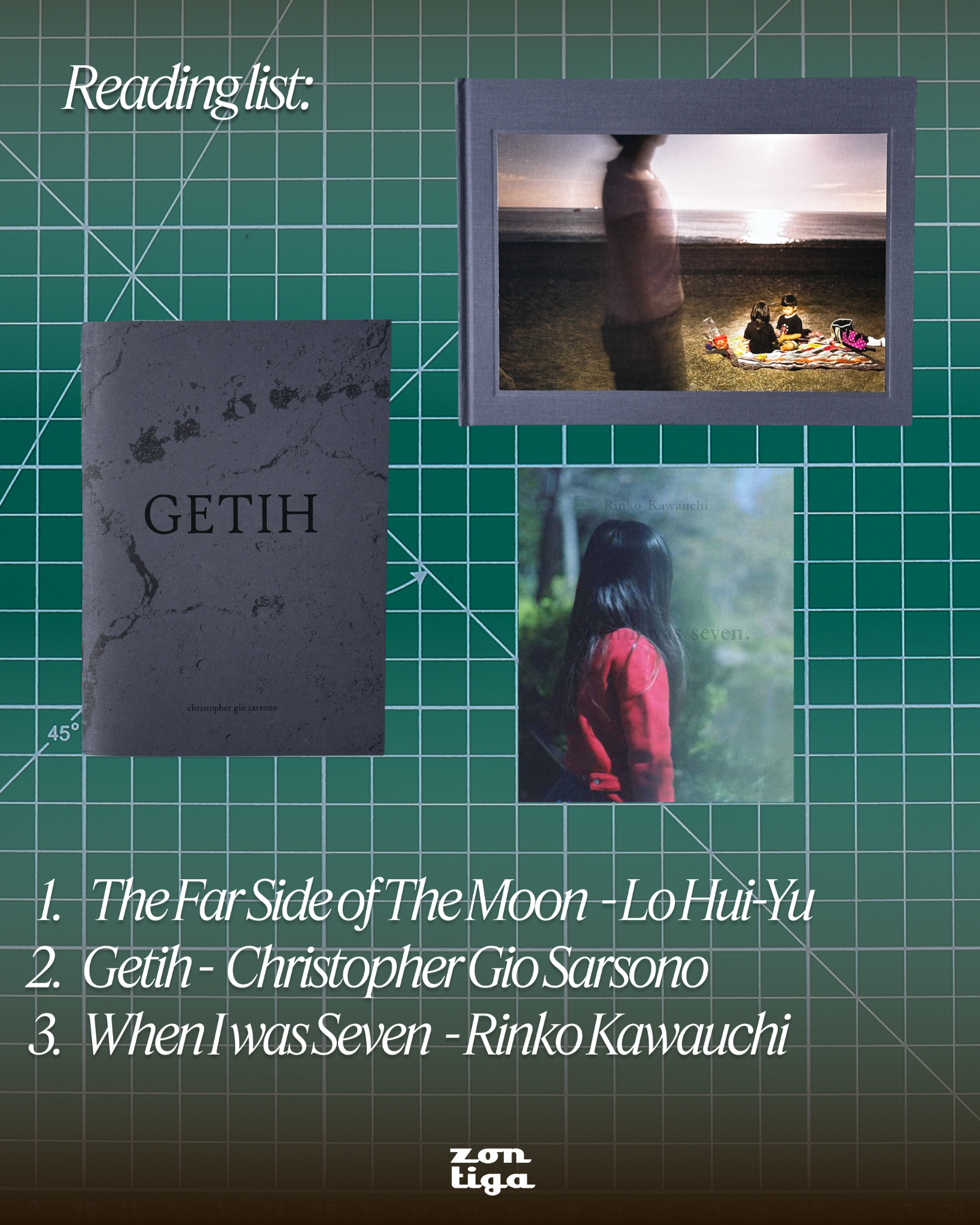
The evening revolved around three photobooks: Getih by Christopher Gio Sarsono (Indonesia), The Far Side of the Moon by Karen Lo Hui-Yu (Taiwan), and When I Was Seven by Rinko Kawauchi (Japan). Christopher Gio Sarsono also joined the discussion while undertaking a residency at Zontiga, allowing participants to move naturally between reading the work and hearing directly from its maker.
Although each publication approached family differently, a recurring observation surfaced throughout the evening: family photographs are rarely only about the people they depict. More often, they become ways of understanding ourselves.
That idea perhaps emerged most clearly through Getih. Built from photographs, family archives, interviews, fragments of memory, and text, the book documents Sarsono’s attempt to understand a father with whom he had long shared a distant relationship. What began as accompanying his father on boar hunting trips slowly evolved into something else—a process of reconstruction.
Participants were drawn to the book’s fragmented structure. Rather than unfolding chronologically, memories appeared as flashes: conversations remembered years later, lingering remarks, unresolved emotions. One participant described the work not as a story about a father, but as a search for identity, quietly asking, “How much of him is in me?” Another observed how the project seemed to move from anger toward understanding, with later pages making space for recognition rather than accusation.
Sarsono later shared that the project had taken shape over four years and through several different versions. Earlier iterations were driven more strongly by anger, while the final form became less about assigning blame and more about allowing multiple perspectives to coexist, including those of his mother, grandmother, and father himself.
The conversation gradually shifted toward memory—not as historical record, but as something unstable, inherited, and continually reshaped. One participant spoke about memories passed down through repeated family stories until they become indistinguishable from personal recollection. Another wondered whether some memories continue to shape us even after we have forgotten where they came from.
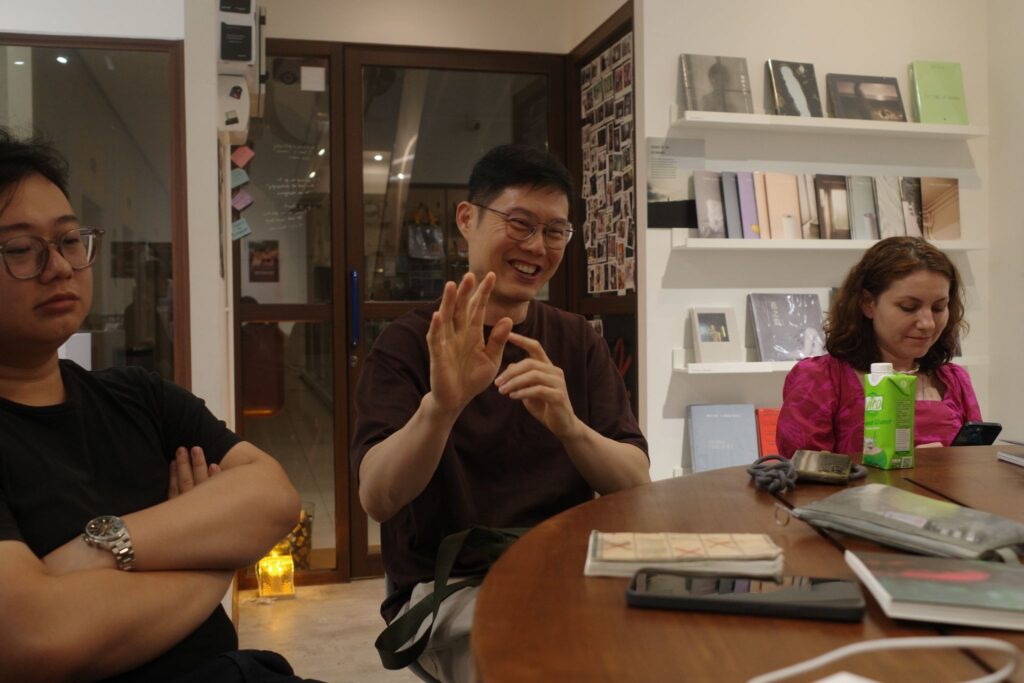

In many ways, all three books seemed to circle that same question.
Rinko Kawauchi’s When I Was Seven approached memory through resemblance. Photographing her daughter at the same age she once was, Kawauchi created a quiet conversation between generations, held together by recurring visual echoes and a cardigan passed from mother to daughter. Rather than explaining itself, the book leaves generous room for interpretation, allowing atmosphere and association to guide the reader.
This naturally led to a broader discussion. How much should a photobook explain itself? Some participants felt artists should leave space for ambiguity, while others argued that understanding an artist’s intentions could deepen the experience of reading the work. No conclusion emerged, but the conversation itself proved more valuable than any definitive answer.
Karen Lo Hui-Yu’s The Far Side of the Moon introduced another perspective on family. Where Kawauchi’s work felt gentle and luminous, Lo’s photographs carried a quieter sense of uncertainty. Spanning three decades, the book reflects on motherhood not as an idealised role but as a lived condition shaped by responsibility, exhaustion, care, uncertainty, and change.
Several participants noticed the recurring presence of the child alongside the partial absence of the mother. Faces drifted in and out of view, while the sequencing itself seemed to fold backwards through time, returning to the person who existed before becoming a mother. Some read this as a meditation on identity, while others saw something entirely different. Once again, the conversation resisted settling on a single interpretation.
The discussion also lingered on the books as physical objects. Participants noticed different paper stocks, bindings, sequencing strategies, and design decisions. Getih‘s saddle-stitched structure allowed multiple paper types to coexist, Kawauchi’s folded pages echoed traditional Japanese publishing, while Karen Lo’s changing paper tones quietly separated emotional and temporal chapters. The books were not simply containers for photographs, but active participants in the way each story unfolded.
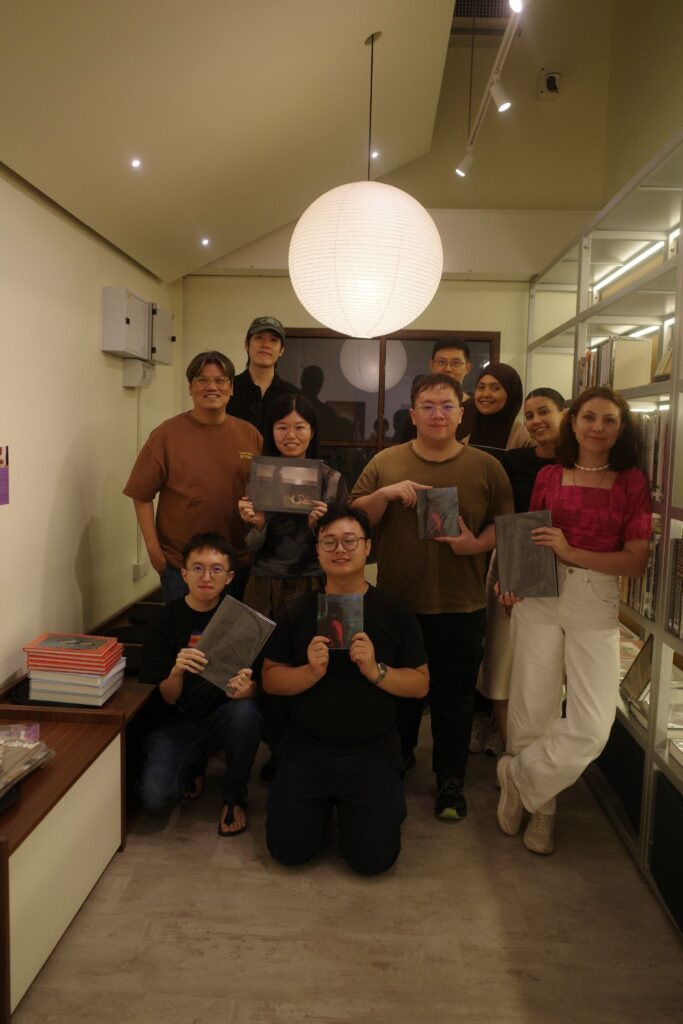
By the end of the evening, what remained most memorable was not any single image or design decision, but the relationships the books invited us to reflect upon: parents and children, mothers and daughters, fathers and sons, and the people we continue to carry within us. Photography, it seemed, offered a way of approaching conversations that might otherwise remain too difficult to begin.
Where previous gatherings often lingered on quietness and solitude, this evening repeatedly returned to inheritance—not inheritance in the material sense, but inheritance as emotion, language, silence, habits, fears, gestures, expectations, and love. These are the things that pass quietly from one generation to the next, often without anyone noticing.
Perhaps that is what these three books ultimately shared. They were not trying to preserve family histories so much as understand what remains within us after those histories have already unfolded.
Perhaps that is also what Reading Photographs is slowly becoming: not simply a space to discuss photobooks, but a place where photographs become starting points for larger conversations about memory, relationships, and the ways we make sense of our lives through images.
Until the next Reading Photographs.
— Zontiga
Kuala Lumpur, June 2026