How William Eggleston Changed Photography by Paying Attention to the Everyday
History Remembers Moments, Not Journeys
Every discipline has defining moments. In photography, history is often organized around exhibitions and iconic images that seem to change everything overnight. William Eggleston is frequently introduced in exactly this way.
The story begins in 1976 with William Eggleston’s Guide, MoMA’s first solo exhibition devoted to color photography. Curated by John Szarkowski, the exhibition and its accompanying publication are now regarded as defining milestones in the medium’s history.
It is an attractive narrative because it offers a clear turning point: before MoMA, color photography struggled for recognition; afterward, its place in the art world seemed secure.
However, history often simplifies. To begin Eggleston’s story in 1976 mistakes recognition for origin. The exhibition wasn’t the start of a revolution, but the moment the photographic world caught up with what he had been quietly discovering for over a decade.
Long before the critics, Eggleston developed a gaze that challenged deep-seated assumptions. He believed a supermarket freezer or a child’s tricycle deserved the same artistic seriousness as a grand landscape, finding enough visual richness in the everyday for a lifetime of work.
The real story of Eggleston is not about color alone, it is about the power of attention.
Growing Up in the Everyday
Born in Memphis in 1939, Eggleston grew up in a South undergoing profound transformation. As post-war prosperity reshaped the landscape with highways, shopping centers, and suburban developments, Eggleston found inspiration in these familiar, overlooked sights.
While 20th-century greats like Cartier-Bresson or Walker Evans sought “decisive moments” or grand social narratives, Eggleston turned his attention elsewhere. He approached photography not to reveal something larger, but to honor the frame itself.
His photographs settled on parked cars, telephone wires, and quiet streets. These are subjects almost too ordinary to notice. At first glance, very little seems to happen, which is precisely the point.
Eggleston recognized that ordinary life possesses its own visual complexity. For him, photography was not about discovering extraordinary subjects, but about rediscovering the world with fresh eyes.
The America Between Destinations
When I first lived in the United States, I expected the country’s identity to reveal itself through its famous landmarks. Back then, like many international students, I imagined the skyline of New York, the monuments of Washington or the Pacific coastline of California as symbols of America itself. Over time, however, I found myself remembering very different places.
The quiet residential streets where afternoons seemed suspended in stillness. Shopping malls surrounded by enormous parking lots. Family diners where conversations unfolded slowly over endless cups of coffee. These places rarely appeared in travel brochures, yet they formed the backdrop of everyday American life.
Having lived and studied there, and returned many times since, I came to realise that these ordinary spaces revealed more about the country than its celebrated landmarks ever could.
Revisiting Eggleston’s work, I recognized those places immediately. His America was not a postcard; it was the world people actually inhabit.
His work resonates because it is about familiarity itself. Whether it’s a Southern intersection of America or a Malaysian coffee shop, Eggleston reminds us that familiarity is not the opposite of beauty, instead it is where beauty quietly resides.
The Democratic Way of Looking
Eggleston famously described photography as “the democratic way of looking.” This wasn’t a political statement, but a method of assigning equal visual value to all subjects within the frame.
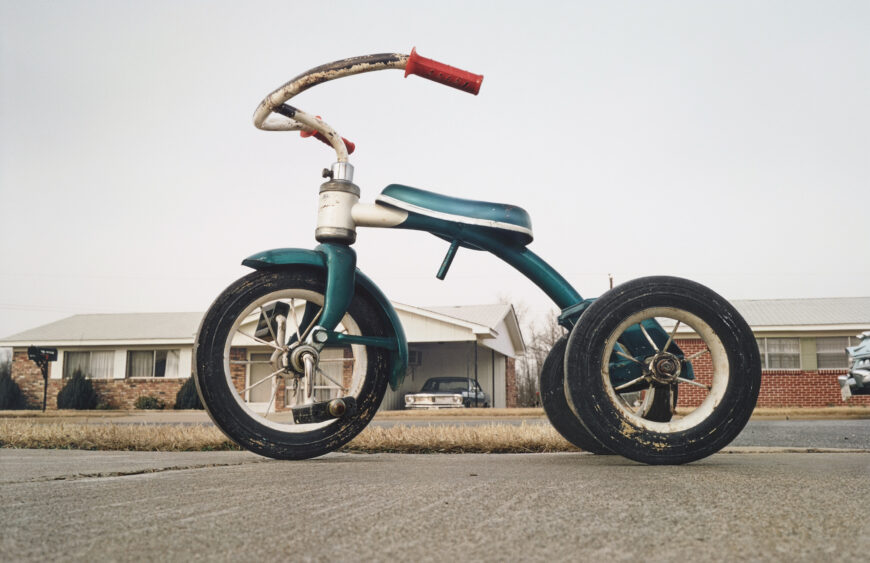
A tricycle was not a lesser subject than a portrait; a roadside sign deserved the same attention as a cathedral. He refused to establish a hierarchy of subjects before making a photograph.
This seemingly simple idea represented a profound shift in photographic thinking. Much of photography had traditionally been built upon selection—finding the extraordinary, isolating the decisive, recognising the exceptional. Eggleston proposed the opposite. He refused to establish a hierarchy between subjects before making the photograph.
Many contemporary photographers reduce his influence to aesthetic imitation; photographing petrol stations simply because he did. But the subject was never the lesson. The lesson was attention.
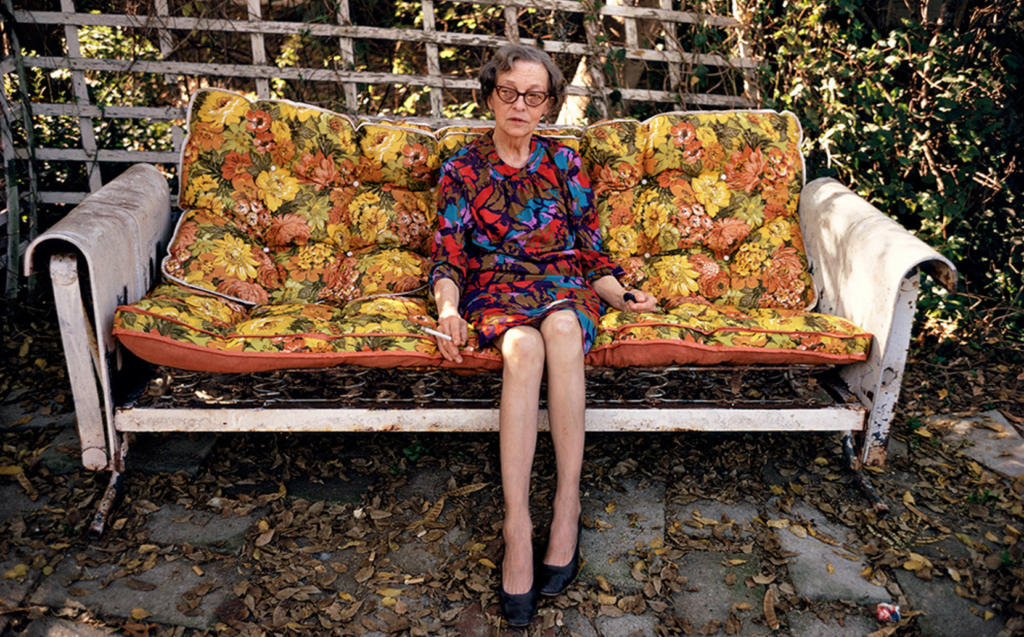
The democratic camera does not ask whether a subject deserves to be photographed; it asks whether we have learned to look carefully enough.
Colour Beyond Description
By the late 1960s, color was common in advertising but viewed with suspicion in fine art. Serious photography was thought to belong to black and white. Eggleston quietly demolished that assumption.
Using the dye-transfer process, he produced prints with extraordinary richness. Color ceased to merely describe surfaces and began to organize the photograph itself.
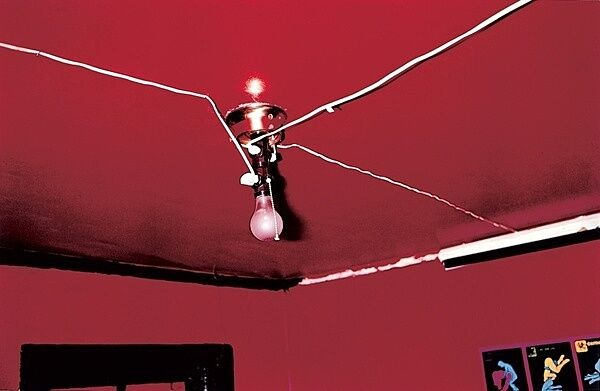
In his celebrated “Red Ceiling” photograph, color is not decoration—it is structure. The saturated red creates a psychologically charged space. Eggleston didn’t just use color; he taught photographers how to think in it.
(To be continued in Reading William Eggleston (II): “Reading Guide: How an Exhibition Catalogue Became One of Photography’s Greatest Photobooks”)