
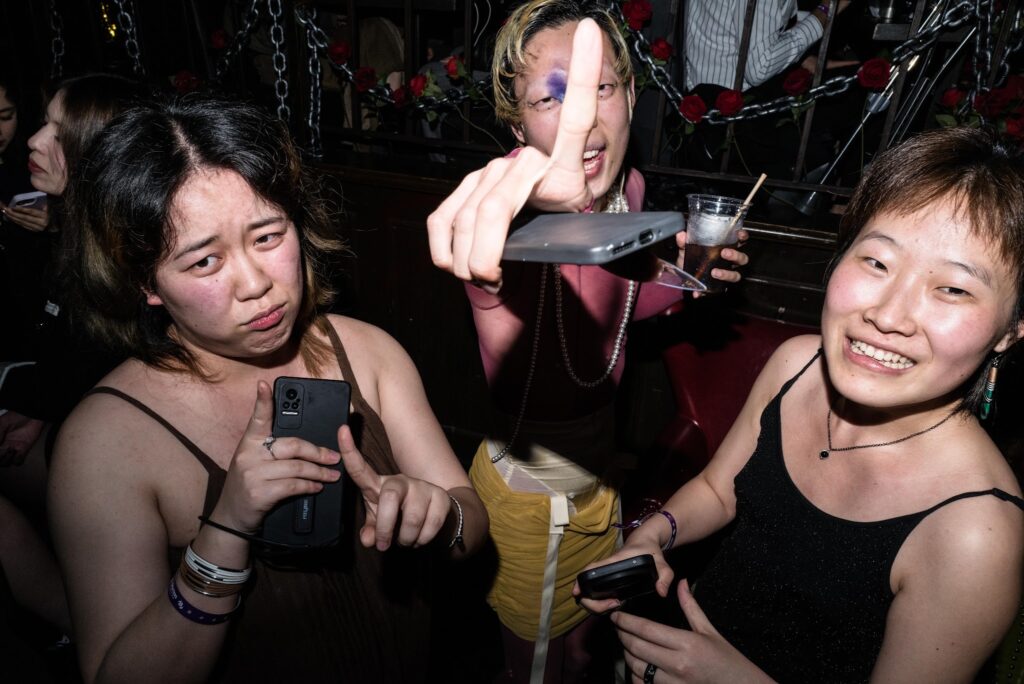
Born and raised in Shanghai, Mi Lu believed he knew his city well. Yet in the spring of 2023, a visit to one of its underground clubs revealed a side of Shanghai he had never encountered before. Behind an unassuming entrance was a world of themed parties, neon lights, extravagant costumes, uninhibited performances, and communities that existed almost entirely outside the image of Shanghai familiar to most people. It was vibrant, welcoming, and surprisingly invisible.
“I instinctively felt that this needed to be documented.”
That simple realisation became the beginning of Rainbow at Night.
Photography, however, did not begin in the nightlife for Mi Lu. When he first picked up a camera in 2013, he was photographing landscapes, spending much of his time outdoors before gradually turning his attention to the streets of Shanghai during the pandemic, when travel became impossible. Street photography transformed the way he understood the medium, shifting his attention away from places and toward people, relationships, and the unpredictable rhythms of everyday life. Along the way he immersed himself in the work of Henri Cartier-Bresson, Robert Capa, Bruce Gilden, W. Eugene Smith, Daidō Moriyama, Garry Winogrand, and Joel Meyerowitz, whose photographs helped shape his own visual language.
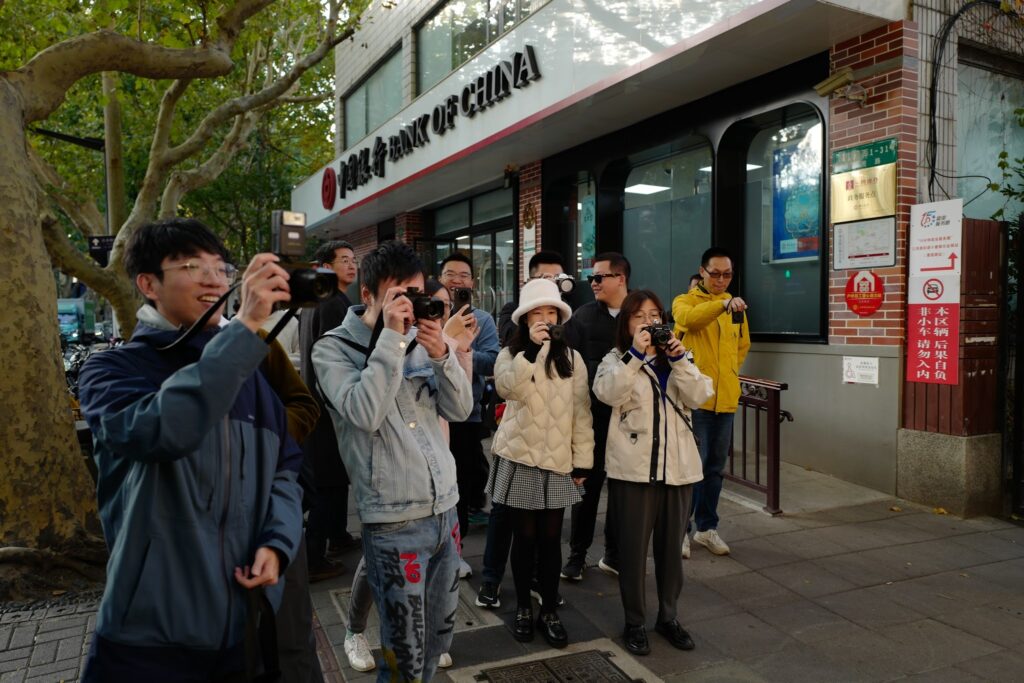
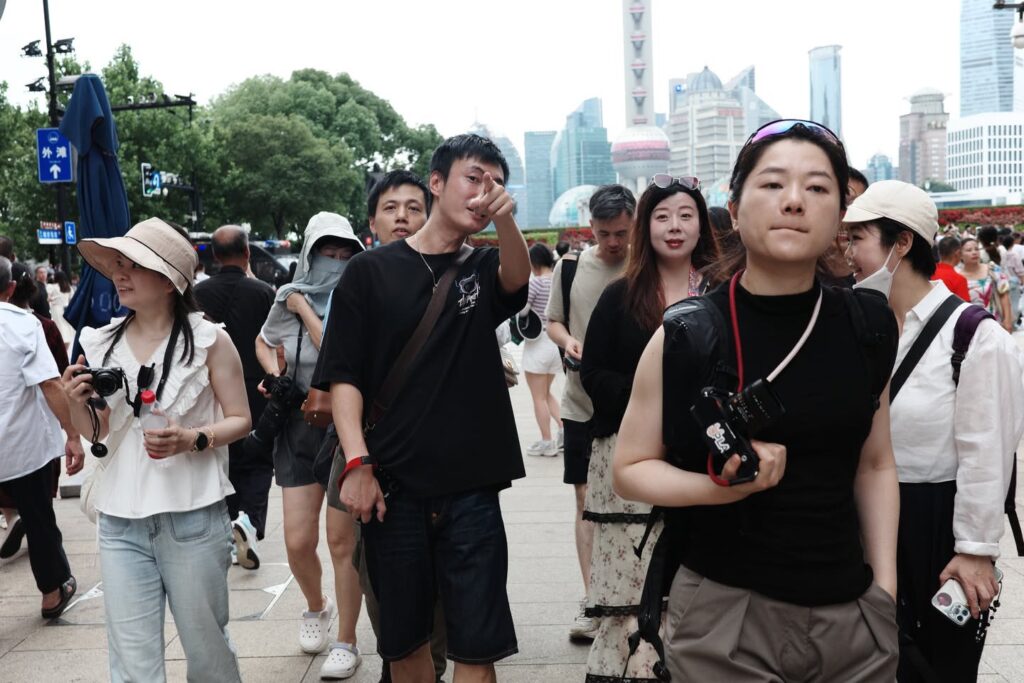
Today, Mi Lu leads the Shanghai L2 Street Photography Community and serves as an official Ricoh GR instructor. More importantly, he hopes photography can become a bridge, introducing Chinese street photography to a wider international audience while encouraging Chinese photographers to engage with photographic communities beyond their own borders. Looking back, it is easy to see how Rainbow at Night emerged naturally from that journey. It was less a departure from his earlier work than an extension of his growing interest in documenting the lives and communities that often remain unseen.

At first, it was never intended to become a serious project. Everything changed when one of the clubs he had photographed only once suddenly closed its doors.
“I already knew this culture was fragile,” he recalled. “But when you witness a place disappear in front of you, it feels completely different.”
That moment transformed the project. What had begun as curiosity slowly became a commitment. If an entire community could disappear so quickly, what responsibility did photography have toward preserving its memory? Over the next three years, Mi Lu returned to these underground spaces again and again, not in search of spectacle or novelty, but to patiently complete a narrative that was still unfolding. Each visit filled another gap in the story until a collection of photographs gradually became a coherent body of work. By the time the book was finished, nearly every club featured within its pages had already closed. Without intending to, the photographs had become historical documents.
Photographing underground clubs was never simply a technical challenge. Darkness could be overcome with experience. Trust could not. Soon after beginning the project, Mi Lu became acquainted with several key figures within the community, and over time those relationships developed into genuine friendships. Rather than raising his camera immediately, he learned to spend time inside the clubs without photographing, allowing people to become comfortable with his presence before making any pictures.
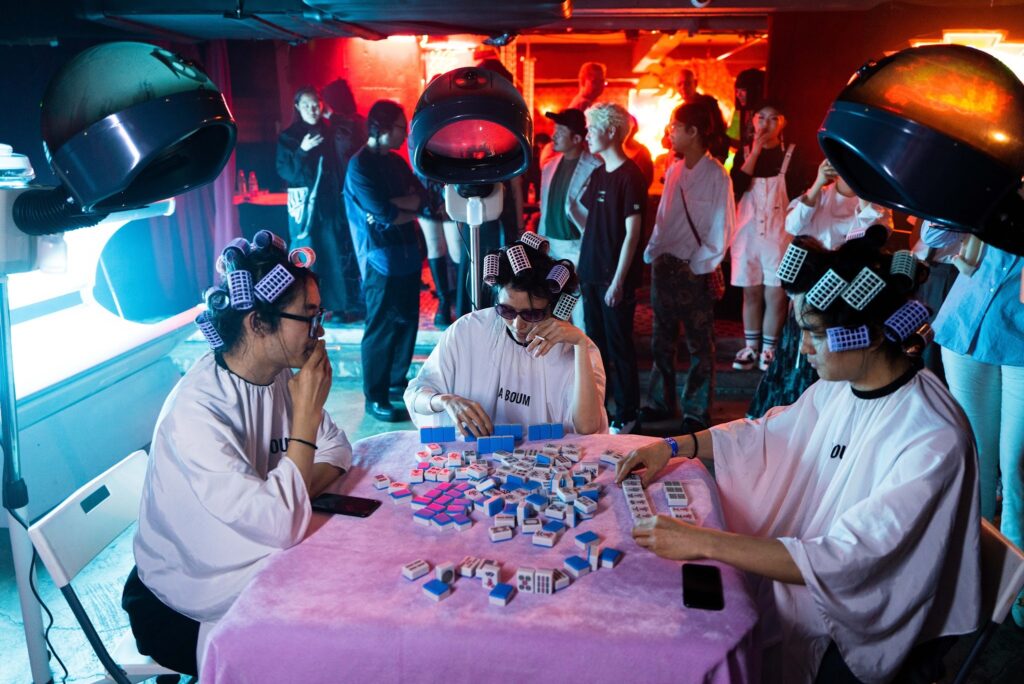


The project, he explained, was never about secretly capturing images. It was about being present. As friendships deepened, conversations naturally moved beyond photography and into life itself. “When we started talking about more meaningful things,” he said, “I felt I had really become part of the group.” Perhaps that is why the photographs in Rainbow at Night never feel like the observations of an outsider. They carry the intimacy of someone who was invited into the community rather than someone merely passing through it.
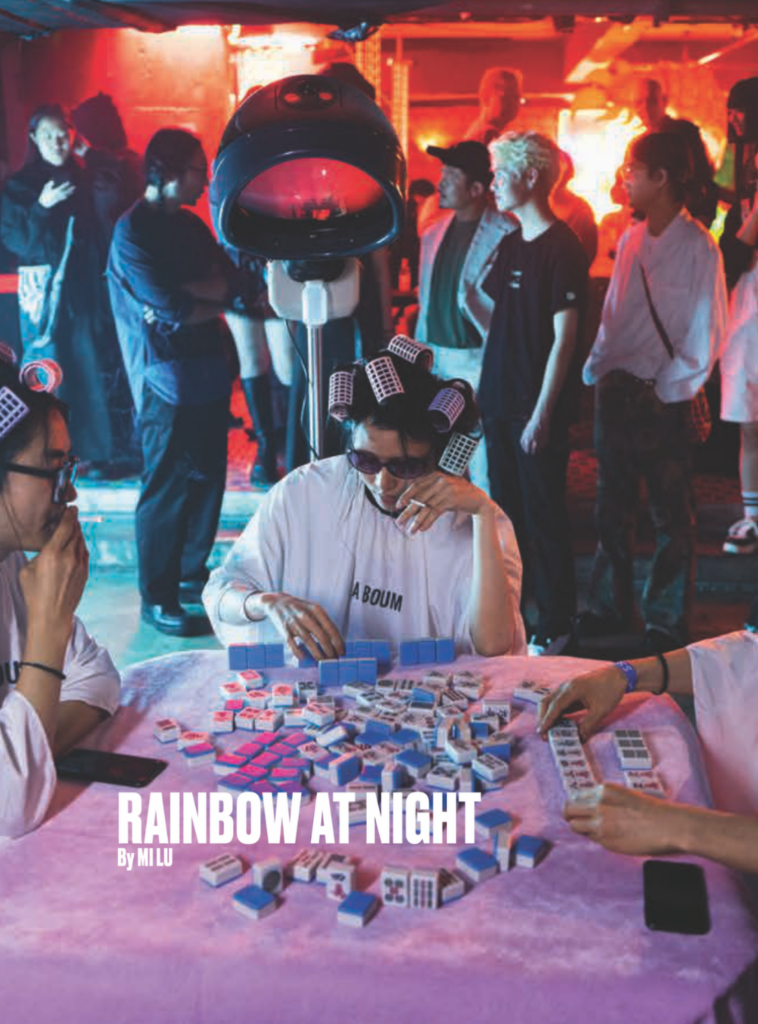
That sense of care also shaped the way the book was made. The project began in black and white using a Leica Q2 Monochrom because Mi Lu believed monochrome would emphasise emotion and human presence. Gradually, however, he realised that something essential was missing. The neon lights, elaborate makeup, costumes, body modifications, and atmosphere of the clubs were not decorative details; they were part of the culture itself. Switching to colour was therefore not an aesthetic decision but an editorial one. Colour completed the narrative.


Editing became equally important. Rainbow at Night is not arranged chronologically. Instead, photographs are carefully sequenced to create visual conversations across the pages, while single Chinese characters quietly introduce different chapters and offer moments of pause before the next part of the journey begins. For Mi Lu, a photobook is never simply a collection of images. It is another way of telling a story.
When Mi Lu first visited Kuala Lumpur, publishing a photobook was the last thing on his mind. He had travelled to Malaysia to photograph Thaipusam and, during that visit, stopped by Zontiga to share the work he had been making in Shanghai. What stayed with him was not simply the bookstore itself, but the community that had formed around it.
“Shanghai is a much larger city than Kuala Lumpur, yet it doesn’t have a photography bookstore and community space quite like Zontiga.”
For us, those words were both encouraging and humbling. Since its founding, Zontiga has believed that photobooks are far more than printed objects. They are places where conversations continue—between photographers and readers, between different cities, and between different ways of seeing. Publishing has never been only about producing books. It is about creating opportunities for those conversations to travel.


When we first encountered Rainbow at Night, what captivated us was not simply its subject matter. Underground clubs have been photographed before. What stayed with us was Mi Lu’s way of seeing. His photographs never sensationalise the people they portray. They do not seek to shock, nor do they attempt to speak on behalf of the community. Instead, they reflect patience, trust, and relationships built over three years of sustained engagement. The photographs feel less like observations and more like acts of witnessing.
There was another reason the project resonated so deeply. By the time the book was completed, most of the clubs documented within its pages had already disappeared. The spaces remain alive today largely because they were photographed. In that sense, Rainbow at Night preserves far more than a subculture. It preserves a fragment of a city’s memory.
For readers across Southeast Asia, the book offers a glimpse into a side of Shanghai that few outsiders have encountered. More importantly, it reminds us that every city contains communities that exist just beyond public view—places that may never appear in travel guides, yet remain deeply meaningful to the people who inhabit them. If nobody chooses to document them, they may quietly disappear without leaving much behind.
When we asked Mi Lu what photography ultimately means to him, his answer was remarkably simple.
“To record.”
The simplicity of that answer stayed with us. Photography cannot prevent places from disappearing, nor can it stop time from moving forward. What it can do is leave traces—of people, communities, and moments that might otherwise vanish without notice. It can preserve the memory of places that survive only because someone cared enough to witness them.

We ended our conversation by asking what single sentence he would leave behind if every photograph in Rainbow at Night were to disappear.
“There is an invisible rainbow in Shanghai’s night.”
Perhaps that is the heart of this book. It is not simply about underground clubs, nor is it an attempt to prove the existence of a hidden subculture. It is a reminder that every city contains lives, communities, and stories that remain invisible until someone chooses to pay attention. Some are fragile. Some are temporary. Many will eventually disappear.
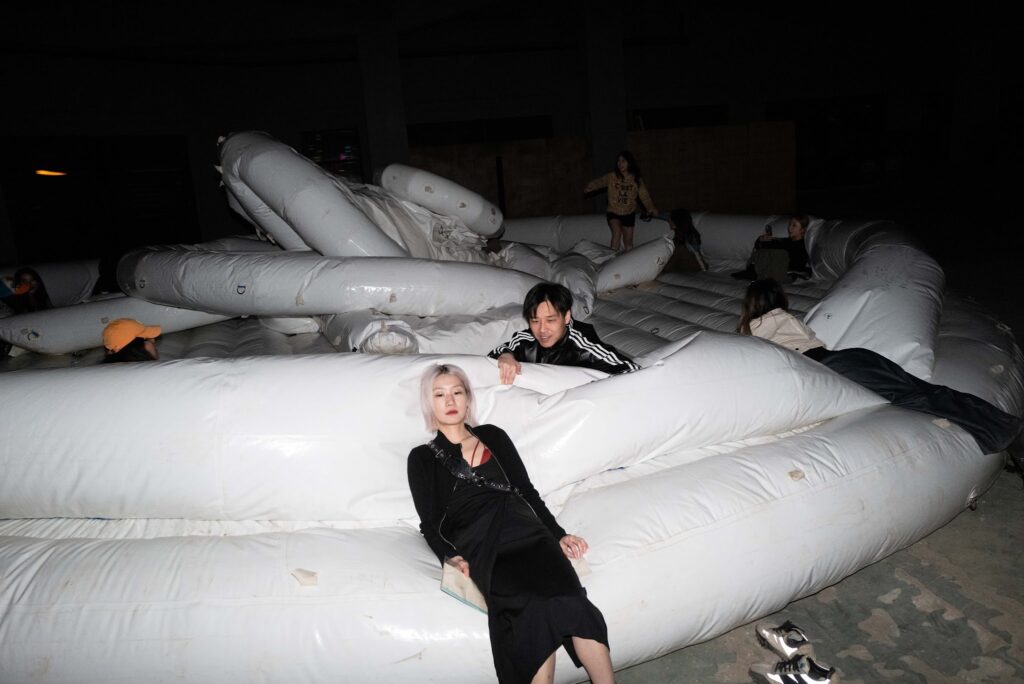
Years from now, readers may no longer encounter only the clubs that once filled these pages. They may instead discover a Shanghai that almost slipped quietly into history—a city remembered through the people who gathered there, the friendships they built, and the photographs that refused to let them be forgotten. Perhaps that is photography’s greatest gift. It cannot stop time from passing, but it can leave behind enough for memory to endure. In Rainbow at Night, Mi Lu has done precisely that, leaving not only a record of a disappearing community, but a quiet reminder that every city has its own invisible rainbow, waiting for someone to notice it.