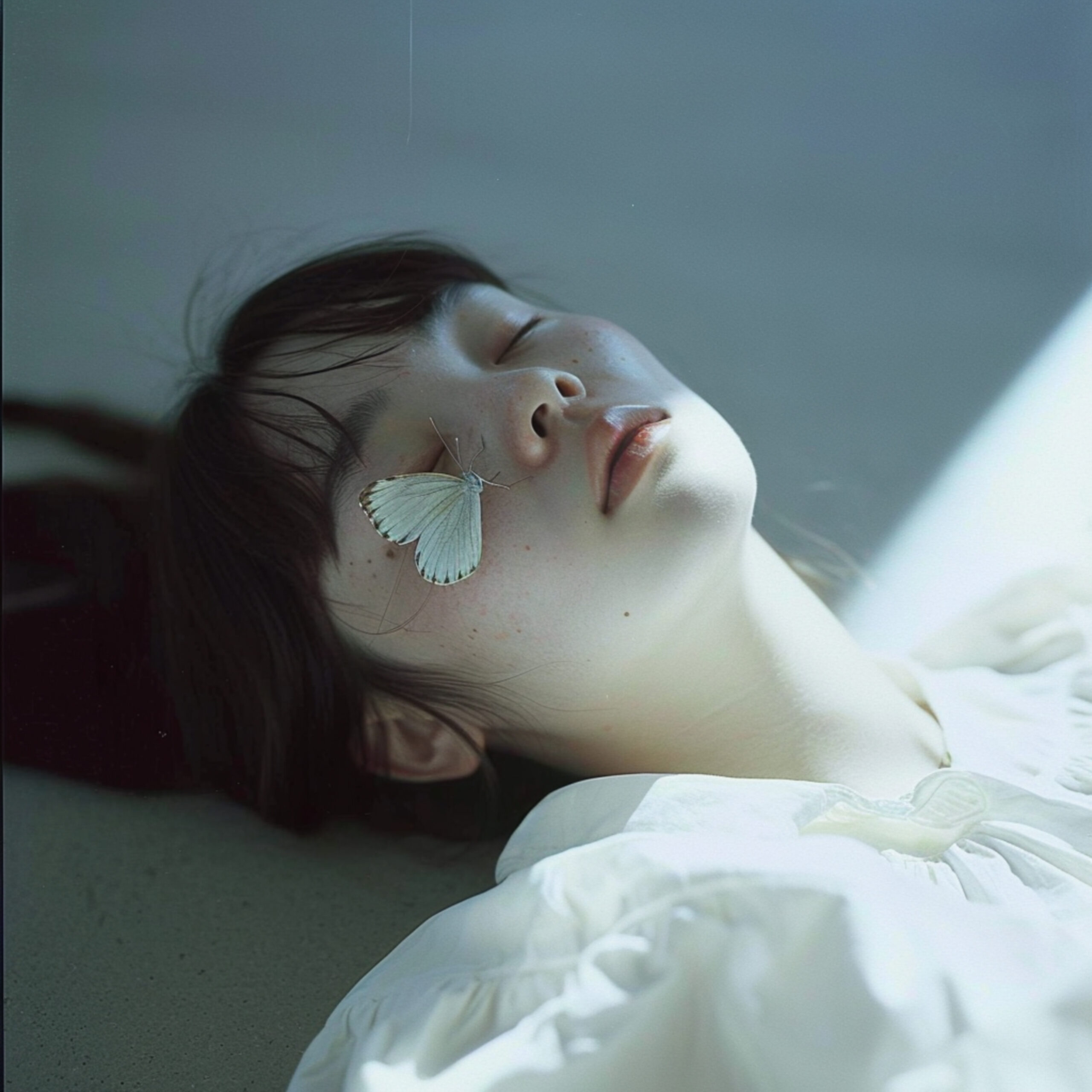
There is a particular discomfort that comes from looking at a photograph when the subject refuses to look back. Not the discomfort of being watched, but its opposite: the unease of watching something that will not yield. You lean in. You search for an anchor. The face that might confirm your position as the one who sees, who knows, who holds the image in place. In Pale Flare’s Miasma, that anchor is never offered. The faces dissolve. The figures turn away or disappear into atmosphere. What remains is sensation without resolution, and that, it turns out, is precisely the point.
To understand why this matters, it helps to start with John Berger. In Ways of Seeing, his 1972 examination of how images carry power, Berger argued that looking is never a neutral act. We have been trained, through centuries of Western painting and the advertising culture that inherited its logic, to approach images as consumers. We expect the subject to present itself for our gaze, to offer itself up for possession. The act of seeing, Berger suggested, is bound up with the act of owning. To look fully at something is to feel, however briefly, that you have it.
This is not an abstract philosophical claim. It shapes the way we move through visual culture every day: the expectation that an image will give us something, will resolve into meaning, will tell us what to feel. When an image refuses this contract, the effect is disorienting. We do not always know why we feel unsettled. Berger would say it is because the terms of looking have changed without our permission.
Miasma changes those terms on every page.


Who is Pale Flare
Napasraphee Apaiwong, who works under the name Pale Flare, is a Bangkok-based visual artist who has been making conceptual images for fifteen years. He studied law at Chulalongkorn University but chose not to practise, turning instead toward a creative life that his legal training never quite predicted. The decision says something about how seriously he takes the interior life that his images explore. The choice was not pragmatic. It was a refusal of its own kind.
His practice began with photography, always conceptual in orientation and less concerned with capturing reality than with constructing images that embody an idea or emotional state. Around the time of the COVID-19 pandemic, when staging photoshoots became logistically impossible, he began incorporating AI image-generation tools into his workflow. The shift was born from constraint but became something more generative. AI, he discovered, could realise images that physical photography could not, not because the tools were more powerful, but because they were more pliable, more willing to inhabit the impossible.
Miasma is his first book intended for public sale, published in an edition of one hundred signed and numbered copies through Bad Eyes. It brought together work made across several years, images he felt a sense of urgency to preserve before advancing AI technology rendered their particular visual texture obsolete. The rooftop image that opens the book, with its indistinct faces and unrealistic architectural details, is kept precisely because of those imperfections. They mark a moment in a practice. They are honest about their own making.


The first refusal: the image that will not be possessed
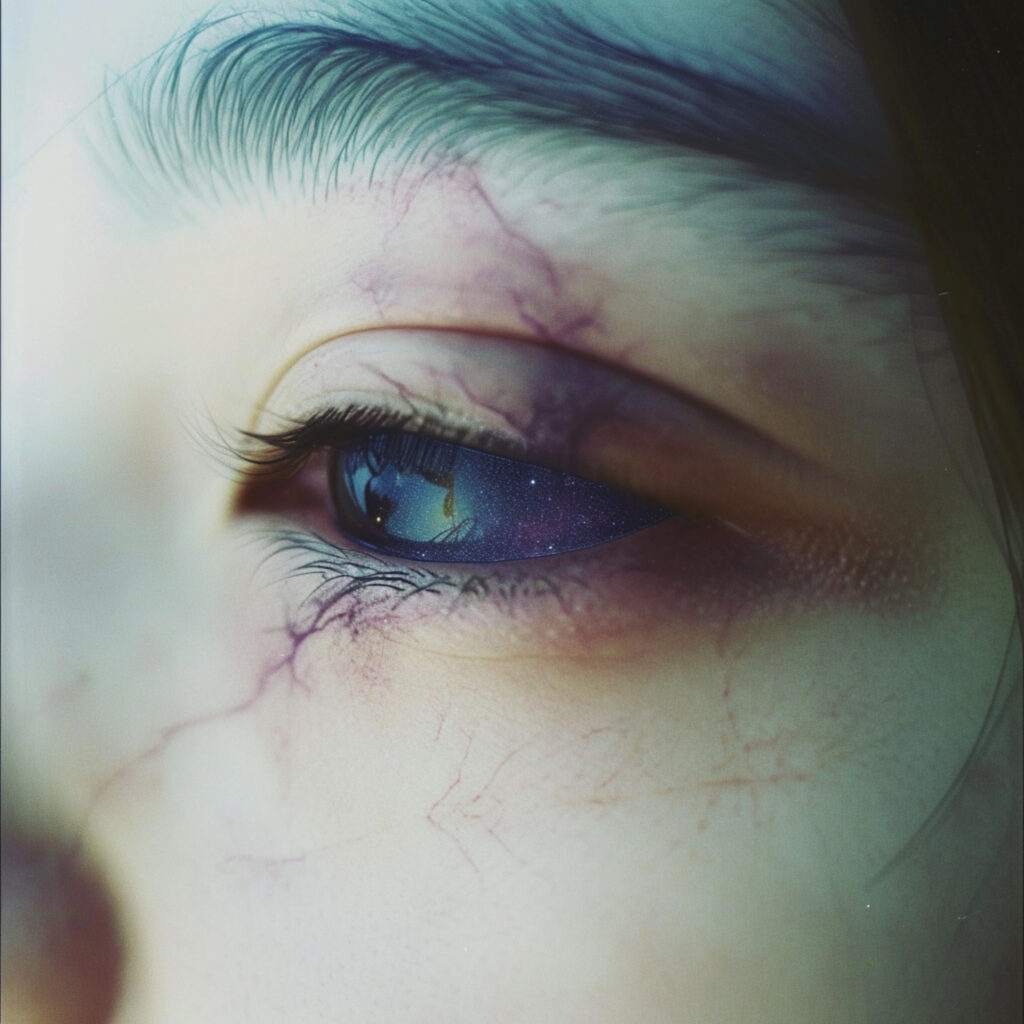
In Miasma, the human figure appears throughout but rarely as an individual. Faces are obscured, dissolved into shadow, or withheld entirely. Bodies become symbolic rather than personal: a vessel for isolation, longing, fear, tenderness, the unnamed weight of being alive in a particular moment in contemporary life.
This is not stylistic preference. It is a philosophical position.
When Berger wrote about the gaze, he was describing a power dynamic built into the image itself. The subject is arranged for the viewer’s eye, aware of being seen, performing legibility. The face is central to this arrangement. It is where we locate identity, emotion, individuality. To see someone’s face is to feel that we know something about them. To possess the image of a face is, in a small but real way, to possess the person.
Pale Flare removes this. The figures in Miasma cannot be known in that way. They cannot be fixed, categorised, or consumed. What the viewer encounters instead is not a person but a presence, a body that carries emotional weight without surrendering identity. The effect is strange and quietly powerful. You find yourself looking at something that feels deeply human while resisting every habit of seeing you bring to human subjects.
This is where Miasma departs most sharply from the tradition Berger described, and where it makes its most interesting argument. The images do not ask to be possessed. They ask to be inhabited.


The second refusal: the book that will not explain itself
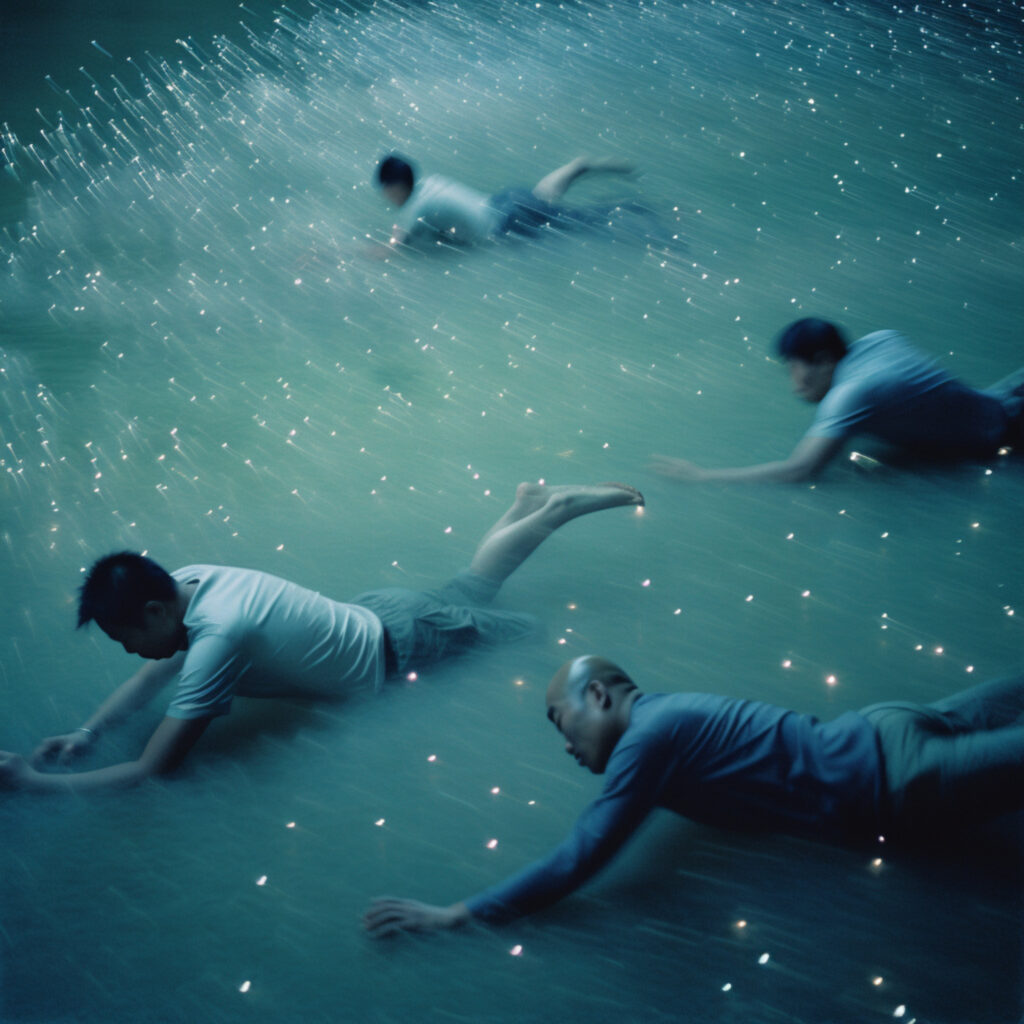
Miasma contains no written text. No artist statement. No titles, no captions, no directions. This is entirely intentional. He
Pale Flare describes an observation about photographic culture in Thailand, though it applies well beyond. Exhibition statements tend to close down interpretation rather than open it. The viewer arrives at an image already told what to think. If their response does not align with the statement, they feel wrong. The statement becomes a kind of surveillance, not of the image, but of the act of looking.
By removing all written guidance from Miasma, Pale Flare refuses this. The viewer is returned to themselves. There is no correct reading. There is only what you bring to the image, your own accumulated emotional history, your own experiences of longing, anxiety, quiet disappearance, and what the image does with that.
This connects to the title itself. Miasma: historically, a toxic or invisible atmosphere believed to carry disease, to settle invisibly into a community and corrupt it from within. The emotional miasma Pale Flare maps is not toxic in that sense, but it shares the quality of being undetectable and pervasive. It is the psychological residue of contemporary life that accumulates through loneliness, overstimulation, unprocessed memory, the grief that has no name. You cannot locate it precisely. You can only recognise it from the inside.
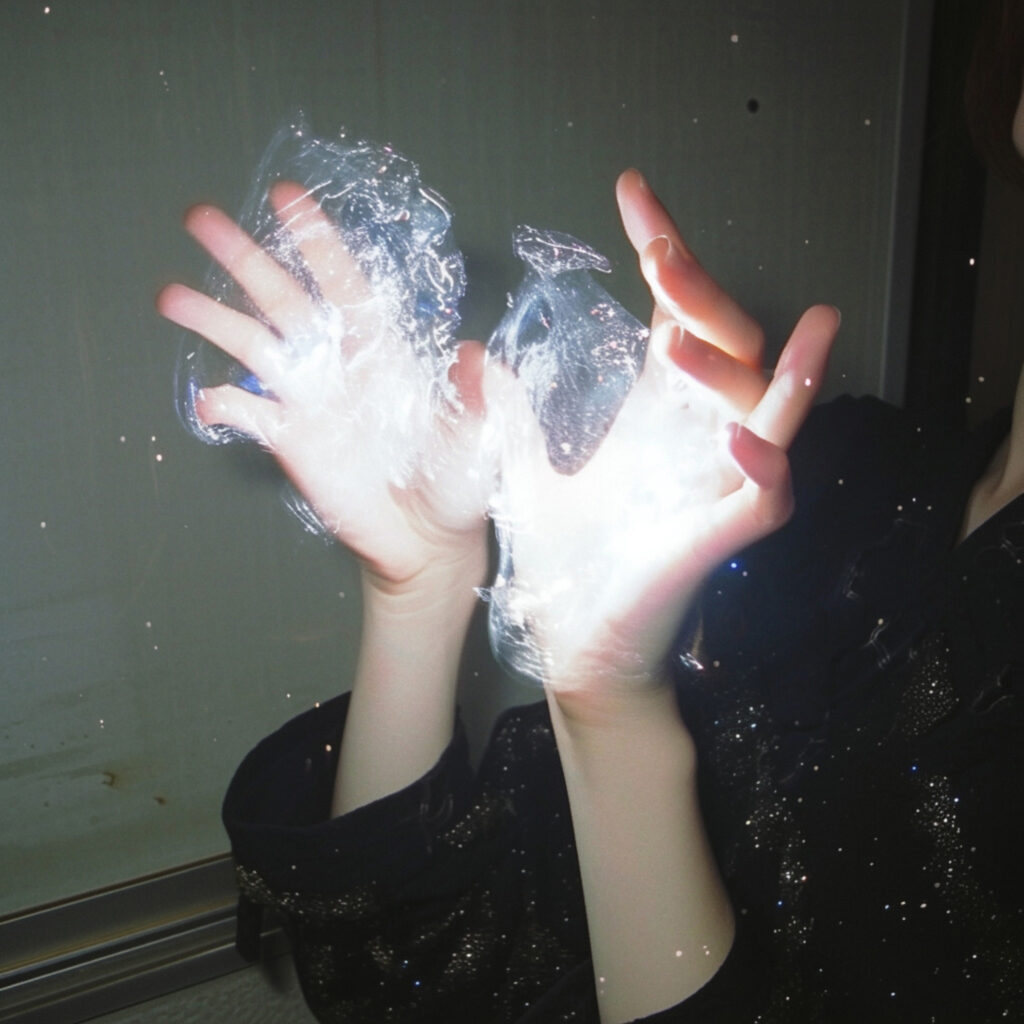
The book is structured to mirror this experience. Pale Flare sequences Miasma like a film or a dream, with an opening movement that sets the atmosphere before the main body begins, then a second section where recurring visual motifs of hands, eyes, and shadows create a deepening sense of déjà vu. The book ends where it began: with eyes. Not the same image, but the same gesture. The structure loops, suggesting that there is no true start or end, only the continual movement of a consciousness through familiar territory that never quite resolves. Like a dream you have had before. Like a feeling you cannot name.


The third refusal: the tool that will not comply
There is a third layer to Pale Flare’s practice of refusal, and it is the one most likely to be misunderstood.
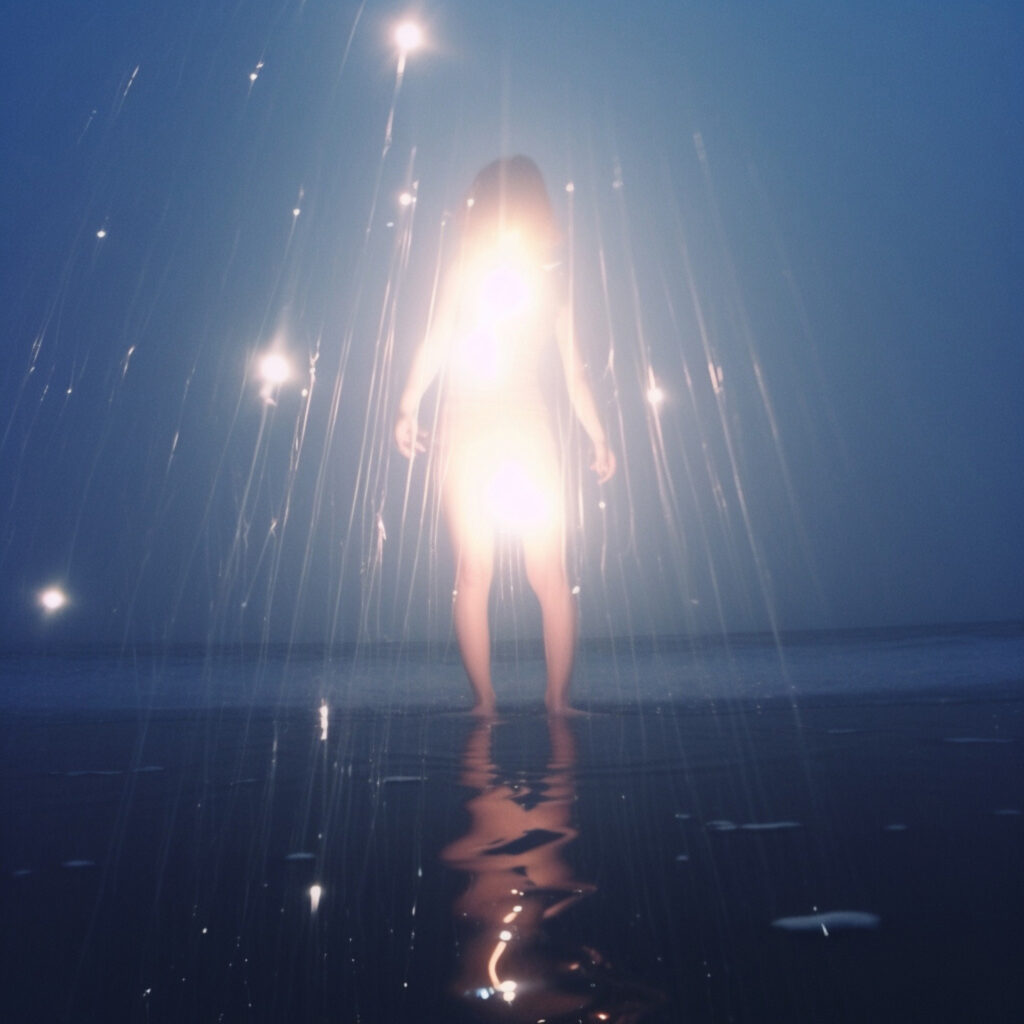
The images in Miasma are made with AI, primarily Midjourney, supplemented by other tools for refinement and detail. This fact tends to trigger a particular kind of conversation about ethics, about authenticity, about whether pressing a button constitutes art. Pale Flare is tired of this conversation, and he is right to be. It is the wrong question.
The right question is what he actually does, and it is considerably more complex and demanding than the press-a-button caricature allows. His workflow involves developing a precise internal vision before approaching the tool at all. Not a vague idea but a specific image, almost fully formed: a person tied to a tree, a pregnant woman holding a cigarette, a figure with a melting candle on their arm. Then begins the work of realising that vision through a system designed to produce the average. AI image tools are trained on vast quantities of human visual culture and their default tendency is toward the generic, the expected, the statistically most likely outcome. To get something genuinely strange and genuinely specific requires working against that tendency. Not asking directly for what you want, but finding ways to pressure the system into deviating from its own mean. Prompting a unicorn without a horn. Using a photograph of a tree to generate a person. Negative prompts, image references, hand-drawn sketches. An iterative, sometimes exhausting process of approximation and refinement.
The images that result often carry the traces of this negotiation. Faces that are slightly wrong. Details that do not quite cohere. The parasite-mouth image in Miasma began as an attempt to render something abstract, and the AI, unable to locate a clear reference, produced something disturbing and funny and not quite like anything. Pale Flare kept it because he felt something when he looked at it. That feeling was the signal.
Pale Flare puts it simply: he could teach anyone to use the same tools in a day or two, but he cannot guarantee they would produce results anything like his. The same is true of a camera. Knowing the shutter speed and aperture does not make you a photographer. What the tools cannot supply is the idea of what the image should be, and that, he says, is the harder problem. The vision precedes the tool. The tool is just the most efficient way to realise it.
This places his practice firmly within the tradition of conceptual art, where the idea has always been primary and the medium secondary. That Miasma was made with AI is incidental to what it is arguing. What it is arguing is something else entirely.
What the viewer completes
Berger’s framework was largely concerned with power flowing in one direction, from image-maker and institution to viewer. The image told you what to see. The viewer consumed.
What Pale Flare proposes is a different arrangement. The images are incomplete without you. The ambiguity is not a withholding but an invitation. The fog you cannot quite locate, the figure whose face you cannot find, the sequence that loops back on itself without resolution: these are not failures of communication. They are the communication.
Resonances of the Concealed, his ongoing series, makes this explicit in its title. What is concealed is not hidden from you so much as preserved for you, kept open so that you might find within it something that belongs to your own interior life rather than Pale Flare’s. This is a generous act and an unusual one. Most images work hard to tell you what to feel. These images work hard not to.
Berger wrote that seeing comes before words, that our relationship to the visual is primary, pre-linguistic, and for that reason largely unexamined. What Pale Flare’s practice asks is that we slow down inside that primary experience. Not to interpret, not to possess, but to recognise. The miasma you encounter in these images is not his. It is the one you carried in with you, the invisible atmospheric weight that contemporary life deposits in all of us, gradually and without announcement.
The book simply gives it a form you can hold.
Pale Flare’s Miasma is available at Zontiga, Petaling Jaya and GMBB, Kuala Lumpur. Edition of 100, signed and numbered.